Last Updated on June 4, 2026
Most reviews about agentic AI courses read like a syllabus. Module names, learning objectives, prerequisites, etc… None of that tells you what you would actually be able to build afterward. This review takes a different approach. It focuses on what Udacity Agentic AI graduates shipped, what technical decisions those projects required, and whether those skills connect to real work.
When we talk about Agentic AI, we are talking about AI systems that can plan, route between tools, maintain context, and complete multi-step tasks rather than just respond to a single prompt. The projects covered here span enterprise analytics agents, RAG systems, tutoring agents, and personal assistant use cases.
If you are evaluating an agentic AI course, project output tells you more than a skill list ever will.
What graduates actually built
The strongest evidence for any program is the work that comes out of it. These agentic AI projects represent a range of real problems, from enterprise analytics to education to consumer wellness. Each one required more than prompting a model. They required orchestration, tool use, role assignment, or state management.
Multi-agent RAG system for a Y Combinator company
Hsin-Wen Chang designed and deployed a multi-agent retrieval-augmented generation system for a YC-backed company. RAG, in short, lets an LLM pull in external documents or knowledge before generating an answer. The system was shipped in seven days.
What made it agentic was the separation of responsibilities. Rather than one monolithic prompt doing everything, the build divided work across agents handling retrieval, routing, synthesis, and verification. That architecture reflects how production systems are increasingly built: specialized components coordinating around a shared task.
For anyone evaluating whether an agentic AI nanodegree program leads to portfolio-worthy work, this is a clear data point. It demonstrates the ability to move from LLM experimentation to an applied, multi-agent workflow inside a real company.
Multi-agent civic exam tutor
One of the more compelling agentic AI examples from the program come from Sabrina Palis, who created a multi-agent civic exam tutoring system. Multiple agents divided the work: one for question generation, one for explanation, one for feedback, and one for personalization.
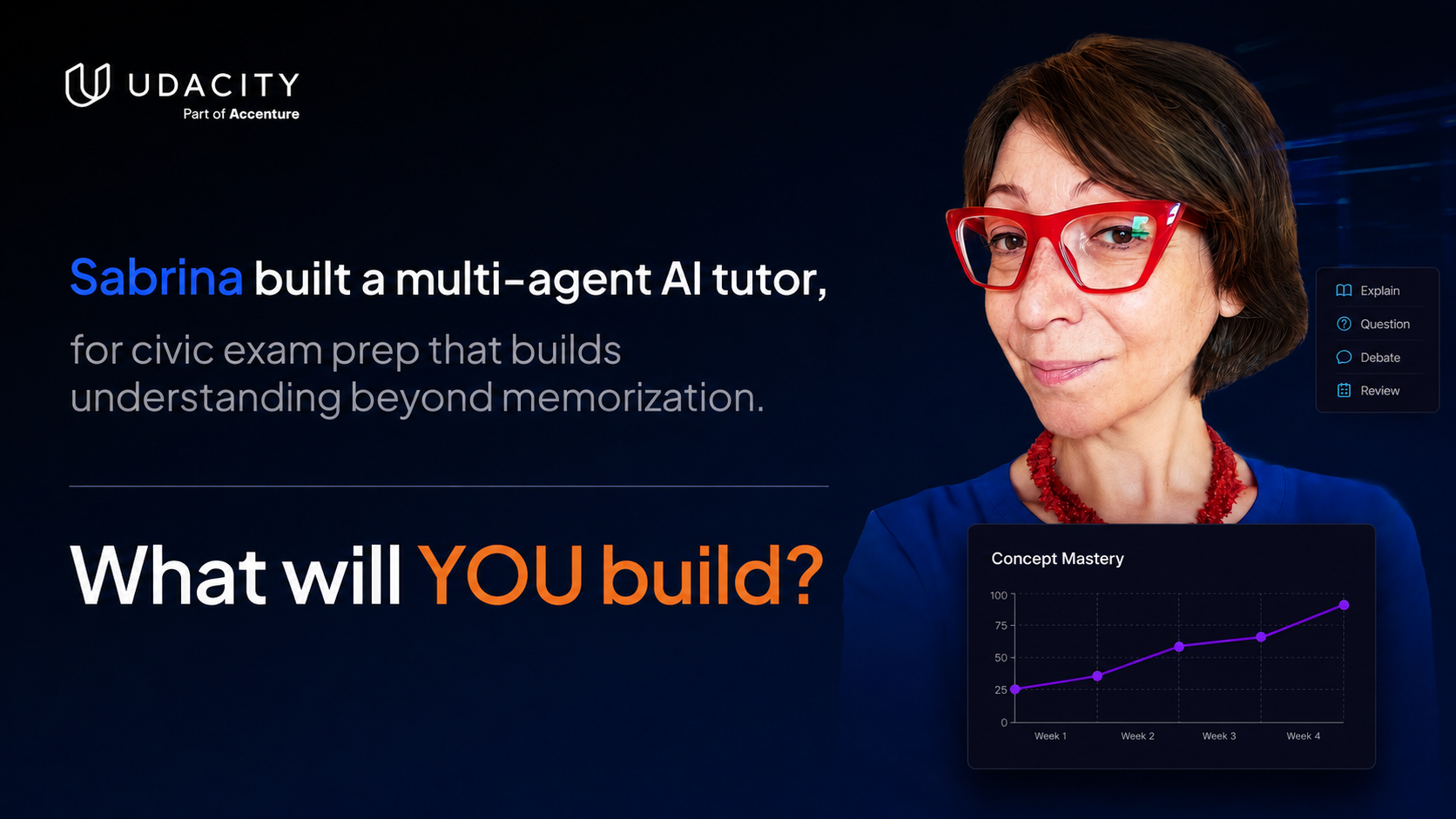
This is a meaningful test of orchestration. A single prompt cannot handle all of those responsibilities well. Each agent has a distinct role and must collaborate within a structured flow. The design requires role separation, sequencing, and careful handling of student context.
Agentic design becomes useful precisely when a single prompt is not enough. This project demonstrates that threshold clearly, and it illustrates the potential for pedagogical AI, public service applications, and adaptive support.
Enterprise analytics agents that cut turnaround time
Shivaji Bojja built an enterprise analytics agent that reduced analytics turnaround by 30%. That is not a vague efficiency claim. It is an operational improvement that affects decision speed, stakeholder responsiveness, and team throughput.
In practice, an analytics agent like this might ingest a business question, translate it into a data query, retrieve or structure the relevant data, generate a summary or visualization, and hand off edge cases to a human. Each step involves a design choice: what gets automated, what gets routed, and where the LLM adds value versus where deterministic logic is better.
This example speaks directly to working professionals in analyst, operations, or technical management roles. It also draws a clear line between agentic systems and simple chatbot demos.
AI sleep assistant and other personal-use systems
Not every useful project targets a Fortune 500 workflow. Valentine Onazi built an AI sleep assistant, applying agent design in a consumer wellness context. The system still required real design decisions: persona definition, memory and preference handling, recommendation logic, and interaction flow.
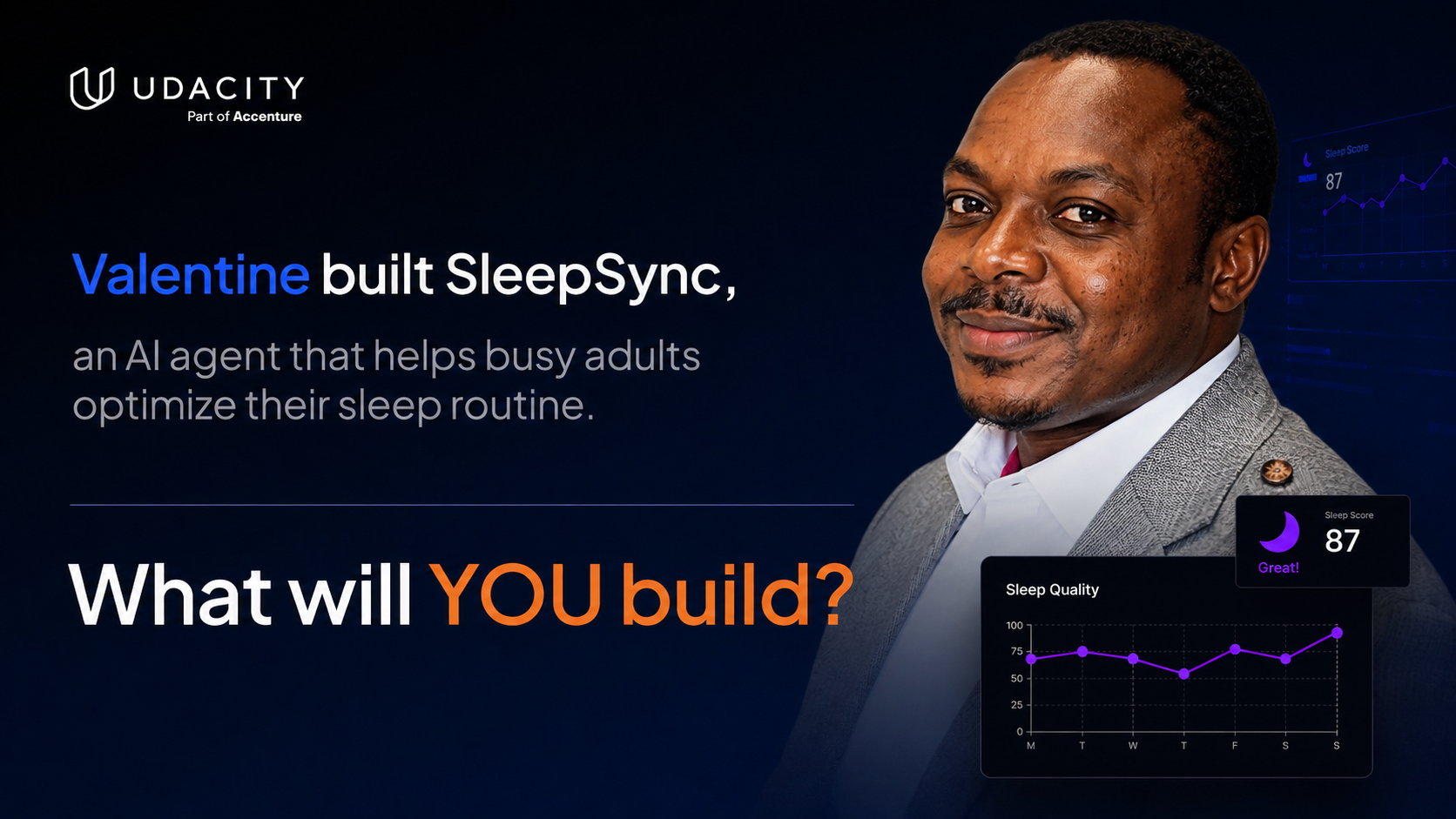
Projects like this widen the range of what agentic AI projects can look like. They also help career changers see that a consumer-facing project can still demonstrate engineering judgment, system design, and thoughtful LLM integration.
What these projects collectively tell you
Across all of these examples, the pattern is consistent. Learners are not just learning terminology. They are building systems that coordinate LLMs, tools, retrieval, and task logic to solve actual problems. That is the most useful lens for reviewing any agentic AI course.
How the curriculum is structured: from agentic workflows to multi-agent systems
Many people hear “AI agents” and picture either a fully autonomous system that replaces entire teams or a chatbot with a new label. The practical reality sits between those extremes. The Udacity Agentic AI curriculum is structured to build from foundational workflow design toward multi-agent orchestration, helping learners find that middle ground.
Start with workflows
The program begins by helping learners distinguish when a workflow should stay deterministic and when it benefits from agentic behavior.
A deterministic workflow is rule-based and predictable. The same inputs always produce the same path. Robotic process automation is a good example: it excels when the process is fixed, well-defined, and repeatable. Invoice processing, form routing, data entry. These are solid automation targets.
Agentic workflows matter when the task is messy, ambiguous, or requires choices along the way. When a system needs to reason about which tool to call, how to interpret an unclear request, or how to adapt its approach mid-task, simple automation is not enough.
Readers evaluating an agentic AI course should look for whether the program teaches judgment about when to use agentic approaches, not just how to implement them.
The LLM is the reasoning layer, not the whole system
Think of a modern AI agent as leveraging a large language model as a core capability. The LLM handles language understanding and generation. But the agent is more than the model.
The surrounding system handles tools, instructions, memory, routing, and constraints. A useful way to break it down:
- Model: the LLM that generates and interprets language
- Prompt and instructions: what the agent is told to do and how
- Tools: external capabilities the agent can call, such as APIs, databases, or search
- Memory and state: what the system tracks across interactions
- Execution logic: how the agent decides what to do next
An LLM app is not automatically an agentic system. That confusion is common, and the Udacity Agentic AI curriculum addresses it directly by teaching learners to build each of these layers. This progression mirrors what professionals need when moving from prototype to reliable workflow.
Build toward multi-agent systems
The curriculum progresses from a single agent handling one workflow to multiple agents with specialized roles. Teams split responsibilities across agents for practical reasons: better task decomposition, clearer evaluation of each component, less prompt overload, and easier debugging.
Common role separations include a planner agent, a researcher or retrieval agent, an executor agent, and a reviewer or QA agent. This mirrors real software architecture thinking. Separation of concerns is not new. Applying it to LLM-powered systems is.
The graduate projects described earlier, from the RAG system to the civic exam tutor, are direct outputs of this progression.
Who this course is for and who it isn’t
| Learner type | Why this course fits | What they are likely to get out of it | What they still need |
|---|---|---|---|
| Working professionals in technical or adjacent roles | They can map projects directly to workflows they already know | Practical agent design skills, portfolio evidence, better judgment about AI workflow design | Time to build and iterate, enough technical comfort to implement |
| Career changers with some coding background | It offers applied projects that are more credible than theory alone | Portfolio pieces, clearer understanding of agent systems, stronger interview stories | Foundational Python or software skills if weak, realistic job search expectations |
| Non-technical leaders seeking strategy only | Limited fit if they do not want hands-on implementation | Some conceptual clarity, but likely more depth than needed | A more executive-focused AI fluency option may be better |
| Complete beginners with no coding foundation | Usually not the best starting point | Exposure to concepts, but the hands-on work may feel steep | Start with Python or AI fundamentals first |
If you already work with data, software, product, automation, analytics, or AI-adjacent systems, this kind of agentic AI course is easier to translate into job value. The projects connect to problems you likely recognize.
If you are changing careers, the agentic AI projects can strengthen your portfolio. But they are not a substitute for fundamentals. Python fluency and basic comfort with APIs and data structures will make the difference between struggling with the tooling and learning the design.
If you want only high-level trend awareness, this program is probably too implementation-focused.
This program makes the most sense for people who want to build, not just browse.
What to expect: pace, projects, and what hands-on actually means here
A realistic weekly rhythm
A typical week in the Udacity Agentic AI Nanodegree program involves reviewing lessons and architecture examples, prototyping a workflow, testing prompts and tool calls, debugging edge cases, and refining a project submission.
Expect to spend regular weekly time building and troubleshooting, not just watching videos. Iteration is part of the process. Projects rarely work perfectly on the first attempt. That is by design.
What hands-on means in this program
Hands-on means designing workflows, making implementation decisions, and producing artifacts that can be reviewed or shown. It does not mean filling in notebook blanks or following a scripted demo.
In practice, hands-on work includes defining agent roles, connecting retrieval or tools, managing prompts and personas, testing failure cases, and improving task reliability. The graduate outcomes covered earlier are the direct result of this kind of effort.
Start with a well-documented process
Strong projects often begin with a process that is already clear and well-documented. This is consistent advice from the program’s instructors, and it is practical.
If the workflow you are trying to automate is unclear, the agent design will also be unclear. Agentic systems work best when the problem has enough structure to model but enough complexity to justify adaptive behavior.
Good starting points for agentic AI projects include repetitive analytics request flows, internal knowledge retrieval workflows, support triage processes, and educational coaching flows. Pick something you understand well enough to describe step by step, then design agents around it.
Final review: is this the right agentic AI course for you?
The strongest case for the Udacity Agentic AI Nanodegree program is not the syllabus. It is what graduates actually built: multi-agent RAG systems, enterprise analytics agents that cut turnaround by 30%, civic exam tutors, personal wellness assistants. Each project required real design decisions about orchestration, tool use, state management, and evaluation.
The practical value breaks down to three things: applied understanding of agentic workflows, portfolio-relevant projects that demonstrate system thinking, and transferable skills from workflow design to multi-agent coordination.
For professionals building skills that matter in the current & future AI landscape, this is the kind of program where the output speaks for itself.
If you want an agentic AI course that shows up in what you can build, not just what you can describe, explore Udacity’s Agentic AI Nanodegree program today.