Last Updated on July 30, 2026
There have never been more ways to learn a new skill. Free tutorials on YouTube. A conversation with Claude or ChatGPT. Countless online courses compete for your time and money. The barrier to online learning is at an all time low.
That makes the choice of which online platform to use more difficult. When online learning is widely available, often for free, the question isn’t, “where can I learn this?”, it’s, “which way of learning truly helps me accomplish my goals?” This decision is driven by two factors: what outcomes will this produce for me, and does it teach in the style which I learn best?
Those are the questions we care most about at Udacity. Not learning for its own sake, but learning that is additive to your career development. It’s why we don’t stop measuring at the finish line. Most platforms, if they report outcomes at all, ask learners how they feel on graduation day, when enthusiasm is highest and the real test hasn’t started. We wanted to know what happens after that — once you’re back at your desk, doing the actual job, finding out whether any of it held up.
To produce the following outcomes report of Udacity Nanodegree program graduates, we collected responses from 1,920 graduates surveyed at graduation and 367 graduates surveyed in a follow-up anywhere from 3-12 months post-graduation. Here’s what they told us.
Do Udacity graduates actually get results?
The outcomes are clear: 96% reported a positive career outcome. Udacity students report real career benefits after graduating from Nanodegree programs. This is a broad metric and ranges from students who reported feeling more confident in their current role to landing an entirely new job. It’s not a satisfaction score. It reflects real change that graduates saw in their working lives. Some went further still, as 16% used their new skills to build their own product or business.
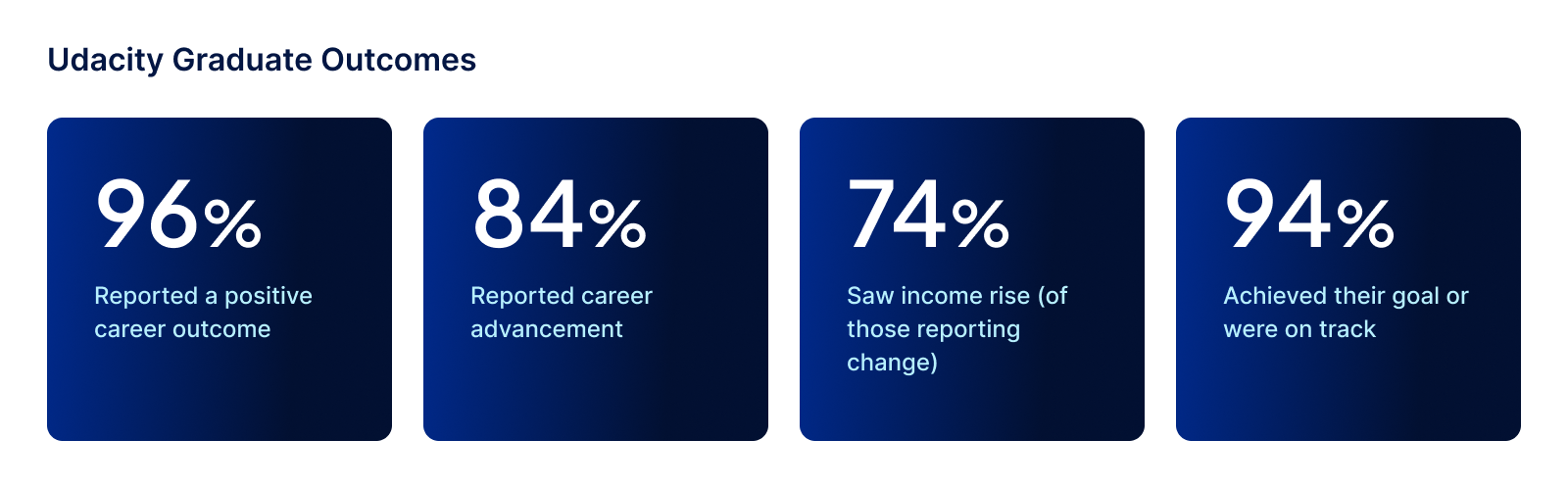
84% reported career advancement, understood as applying new skills in their role, gaining confidence and responsibility, working more efficiently, or earning a raise. This is the stronger signal within that 96%: not only that something changed, but that learners advanced in their careers.
Among graduates who reported a change in income, 74% saw their income rise within a year of graduating.
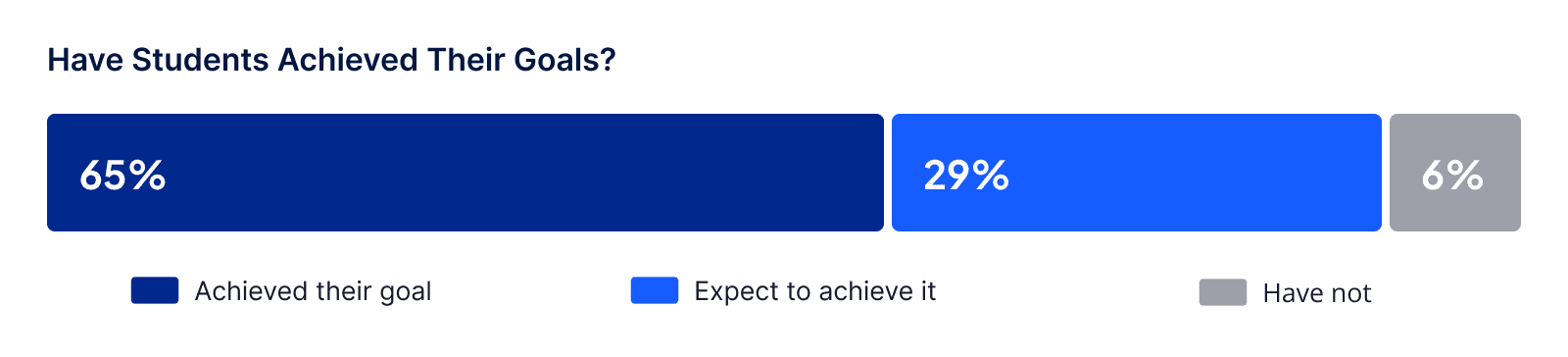
94% had achieved their goal or were on track to achieve it, with 65% having achieved it already.
“After completing my Nanodegree, I cut manual operational work by up to 40% by offloading tasks to AI, and have since been promoted to Principal Product Manager.”
Gilian De Raes — AI Product Manager ND
How long does it take to see results?
The data tells a story about how career impact actually unfolds and it follows a clear arc. You learn. You apply what you’ve learned. You get recognized. Those stages don’t happen at once, and they don’t always happen on graduation day. They progress as you have more time to demonstrate your new capability.
More than half of graduates report applying new skills within approximately 3 months of graduating. Learners bring what they learned back to their current role, start using it in their day-to-day work, and begin contributing outsized value. The bigger moves like new roles, promotions, and meaningful income gains tend to start after 3 months and peak at the 6-month mark, once the applied skills have had time to demonstrate their value in context.
“I was already working as a mechanical engineer but didn’t know how to bridge the gap into data analytics. After Udacity, I gained hands-on experience, built a strong portfolio, and landed a data analyst role at a tech company within a few months.”
Dipesh Budhathoki — Data Analyst Nanodegree program
How does Udacity deliver career outcomes?
Outcome data tells you what happened. It doesn’t tell you why. That part requires looking at how the learning is actually designed.
When graduates in our survey were asked what drove their success, two things stood out: real-world projects that applied directly to their work, credited by 44% of respondents, and content that was current, relevant, and built to be retained rather than completed, credited by 33%.
That result is not accidental. It reflects how Udacity deliberately builds its programs.
Every course is designed backwards from a project, and more specifically, from the question of what a person doing this job would actually need to do on a given day. Instructors are not generalists or professional educators. They are practitioners in the field, sourced because of their domain expertise, then partnered with technical content developers who apply pedagogical rigor to every module, every demo, every exercise.
The goal is not to cover a curriculum. It is to prepare a learner to do real work, which means setting projects in exercises in real world scenarios. The datasets are representative of actual problems. The projects are designed so that the skill being taught must be applied in context, not demonstrated in a controlled exercise that bears no resemblance to the job. A marketing program builds a real campaign brief, runs synthetic persona research, tests creative, builds a forecast, and calibrates it against holdout data — because that is what a marketer does. A data science program builds production-ready models, not toy examples. When Udacity students earn their graduation certificate, it’s not so much a demonstration of completion as it is evidence of capability.
Content is held to a similar standard. Modules are structured so learners can retain and reuse what they learn. Lessons are built around the decisions practitioners actually face, like when to use a tool, how to evaluate a result, and how to defend a recommendation to a skeptical stakeholder. The measure is not whether the learner finished the video. It is whether they can do the thing.
“I was a category manager watching AI reshape procurement from the sidelines. I wanted to be the person driving AI adoption in my business, not the one catching up. Now I understand how the pieces fit well enough to make sound decisions and explain them to my executive team. It’s accelerated my goal of becoming an AI champion in the procurement space.”
Jessica Hawa — AI for Business Leaders
The graduates who get results are, consistently, the ones who treat the program as a preparation for work rather than a credential to collect. That finding is consistent throughout the data: outcomes go to learners who applied what they learned and who created the opportunity to use their skills. The program gives them something worth applying. But it’s still incumbent on the learner to then go on and proactively apply those skills.
AI skills are outperforming
Across every outcome we track (goal achievement, career advancement, and concrete employability gains) AI programs consistently outperform other programs. Graduates of AI programs were 10 percentage points more likely to achieve their goal (78% vs. 68%) and 9 points more likely to report a concrete employability outcome like a new job, internship, or freelance work (51% vs. 42%).
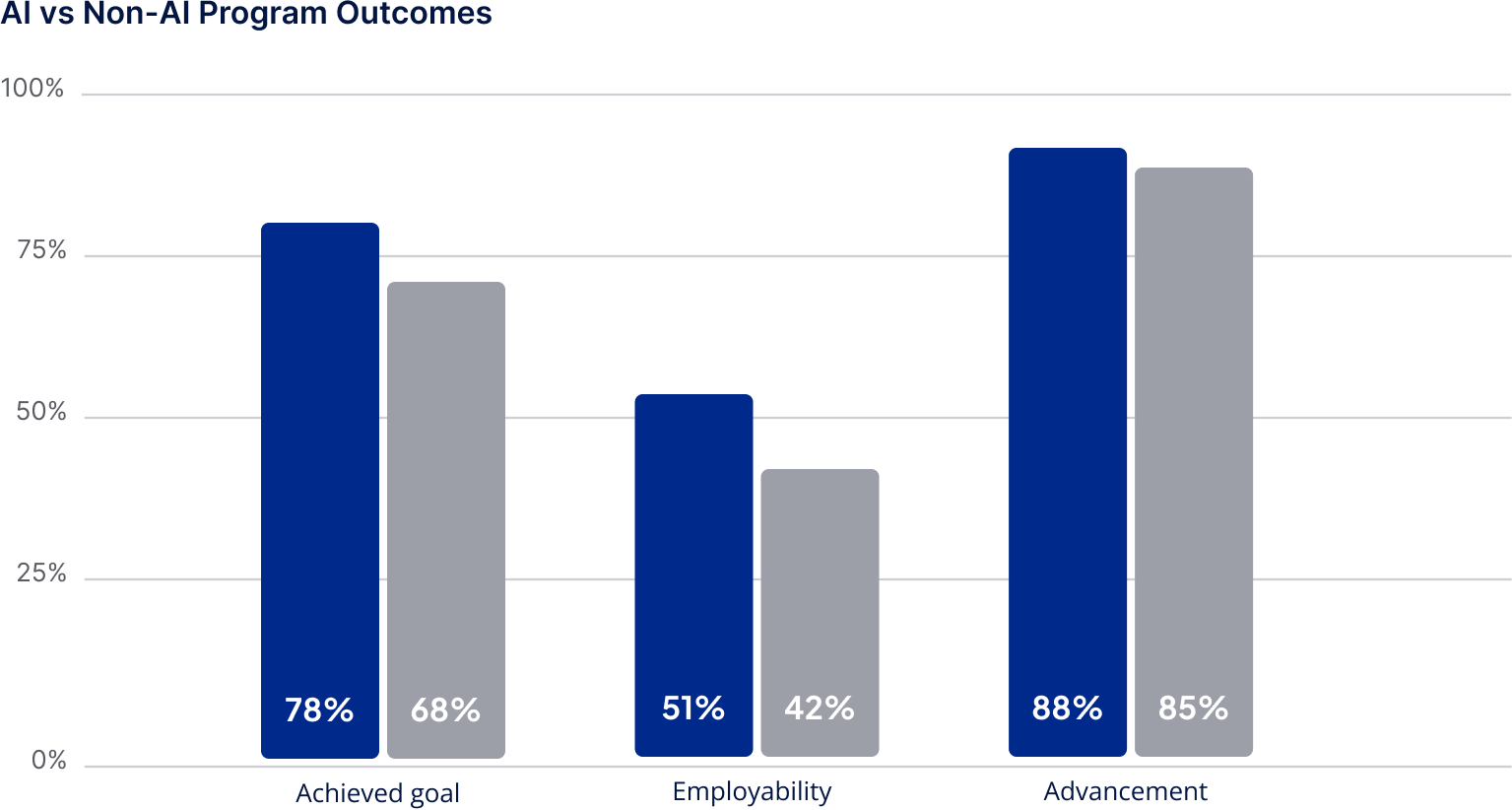
For learners considering an AI-focused program, the outcomes data are consistently encouraging. AI skills are in high demand, and the graduates who build them are finding that they translate quickly into visible workplace impact.
The impact goes beyond careers
For a meaningful number of graduates, the outcomes extend beyond professional advancement. A number of graduates reported progress that was personal as well as professional — continuing their education while managing a family, transitioning out of the military, returning to work after time away.
“Being on maternity leave, I was scared I would fall behind in the tech world. This helped me stay up to date with the latest technology and Product Management processes, and progress my career.”
Krichelle Norgard — AI Product Manager ND
What will you build?
The skills that matter in tech are evolving at a rapid pace. Staying relevant has less to do with what you know today than with how well you can learn what’s next. That’s not always easy. It takes time, effort, and then making the right choice on where to apply that time and effort.
The options are vast and can be overwhelming. What matters is evaluating them honestly on how well they fit the way you learn and on the outcomes they actually produce for learners. That’s the standard we hold ourselves to. It’s why we follow our graduates well after they graduate, and why we publish what we find.
Explore our catalog and start building today.
A Note on Methodology
These findings come from Udacity’s Q2 2026 learner outcome surveys. We survey learners at two points: when they complete their program, and again 3 to 12 months later, to see how outcomes develop once they are back at work. This report draws on 1,920 graduates surveyed at completion and 367 graduates surveyed in the post-graduation follow-up.
Every figure represents the share of survey respondents who reported a given outcome, not the share of all Udacity graduates. A few things are worth being clear about:
- Responses are voluntary and self-reported. Learners choose whether to take part, and outcomes such as raises or promotions are as reported by graduates, not independently verified. As with any voluntary survey, respondents may skew toward those with more positive experiences.
- “Positive career outcome” is a broad measure. It captures any meaningful career benefit a graduate reported, from applying new skills and gaining confidence in a current role to landing a new job or earning a raise. It does not mean every respondent changed jobs.
- Timing is directional. Most post-graduation responses came from learners 3 to 6 months out, so the patterns we describe around when outcomes appear reflect general tendencies in the data rather than fixed timelines.